
Network & Wifi in Manali: The Honest Coverage Guide
In and around Manali town, Jio and Airtel 4G both work well, with Jio usually the steadiest for video calls. Coverage thins as you climb: it holds to Solang and Atal Tunnel, then drops off toward Sissu and Lahaul, where BSNL is often the last signal standing. For a workation, plan your calls for morning and carry two SIMs.
We get this question by WhatsApp almost every week, usually a version of the same worry: "I have three calls a day, will your wifi hold?" So we started keeping notes. Every guest who works from here becomes, without meaning to, a little coverage experiment, and after four winters of this we've got a fairly honest map of where the bars live and where they don't. This is that map.
The short version: which SIM to carry
If you are bringing one SIM to Manali, make it Jio or Airtel. Both run solid 4G across town, along the Mall Road stretch, and down the highway past us at Badgran. In our own testing on the farmstead lawns, Jio has been the more reliable of the two for anything that needs upload — video calls, sending large files, backing up photos. Airtel is a close second and sometimes wins inside town buildings.
BSNL is the one nobody thinks to bring and half of you will wish you had. It is patchy in town and slow when it works, but it reaches into places the private networks abandon — the road past Solang, parts of the Rohtang approach, the far side of the Atal Tunnel. If your trip includes Sissu, Chandratal, or anything Lahaul-side, a BSNL SIM as a backup is worth the small hassle of buying one.
Vodafone Idea (Vi) we'd skip for this valley. Coverage is thin and inconsistent up here; we've watched guests fight it for two days before switching. If Vi is your primary, pick up a Jio number for the trip.
Coverage by area, as we've actually seen it
Geography does most of the work here. The Kullu–Manali–Solang axis is a narrow valley with the town in the middle, and signal follows the road and the towers along it. Step behind a ridge and it goes quiet fast.
- Manali town, Mall Road, Old Manali: strong Jio/Airtel 4G, occasional congestion in peak season (May–June, Dec–Jan) when the town is full and everyone is streaming at once.
- Badgran / 14 Mile (our flagship, ~14 km south of town): reliable Jio and Airtel on the highway and in the rooms — this stretch sits right on NH-21 with towers nearby, which is one reason we can offer a real working day here.
- Shanag / Bahang (our second home, ~4–5 km north toward Solang): good Jio/Airtel, a touch more variable than Badgran because you're higher and the valley narrows; fine for calls, occasionally a dropped bar in heavy weather.
- Solang Valley (~13 km from town): 4G holds at the base but gets crowded and slow on busy days; expect to wait for a message to send when the paragliding crowd is thick.
- Atal Tunnel south portal: signal present but weakening; treat it as the edge of dependable coverage.
- Sissu, Koksar, Lahaul side (through the tunnel): private networks fade to nothing in stretches. BSNL is your best and sometimes only bet. Assume you are offline and be pleasantly surprised.
- Rohtang Pass / high passes: essentially a dead zone. Download offline maps before you leave town.
One honest caveat: coverage is not static. Networks add and lose towers, and a heavy snow spell or a landslide can knock a link out for a day. Winter storms occasionally take the whole area's connectivity down for a few hours — it's rare, but it happens, and no host in this valley can promise otherwise.
Real speeds, not the ad numbers
Here's what we see on the ground. In town and at Badgran, a good Jio 4G connection lands somewhere around 15–40 Mbps down and 5–15 Mbps up on a normal day — plenty for video calls, cloud work, and streaming. On a congested evening in peak season that can sag to single digits, which is exactly when your call to Bangalore stutters. It isn't the tower failing; it's a few thousand tourists all online at 8 pm.
5G has been rolling out across Himachal and you'll catch it in and around town on Jio and Airtel, with noticeably faster speeds when it connects. Don't build your plan around it up here, though — indoors and at altitude it often hands back to 4G, and 4G is what you should assume you have.
Our wifi at both homes runs on the same wired broadband-plus-mobile backbone as everything else in the valley, so it's honestly good, not magical. It's a family farmstead, not a co-working tower. It handles calls and normal remote work comfortably; it is not the place to upload a 4K film edit on a deadline with zero fallback.
“We tell every workation guest the same thing on the WhatsApp before they arrive: keep a mobile hotspot ready as your plan B, and schedule the call you cannot afford to lose for the morning. We've learned that the hard way, on a guest's behalf, more than once.”— A note from the hosts
Why mornings are the sweet spot
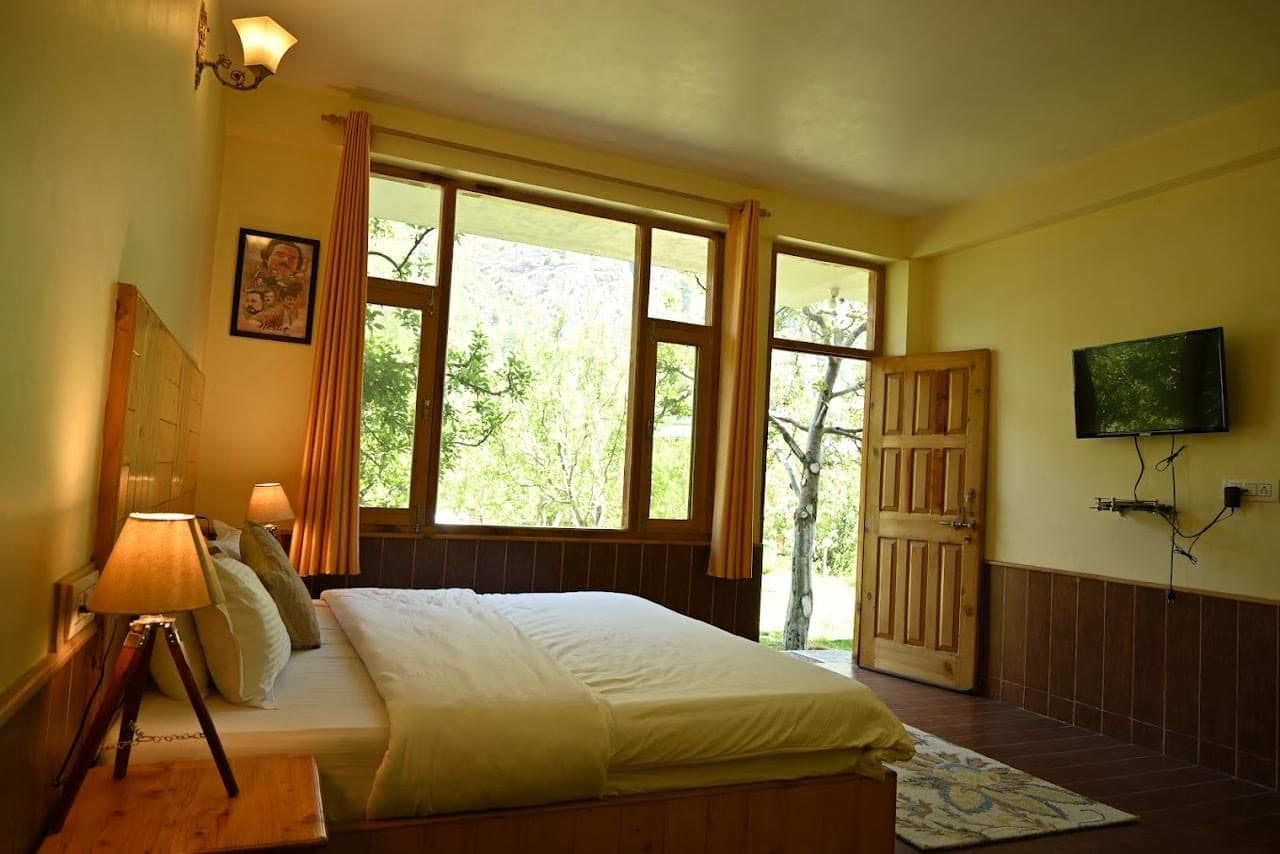
Two reasons, and both are about the crowd rather than the technology. First, the network is emptiest in the morning — the tourists are still at breakfast or heading out, so the towers aren't fighting thousands of streams. Second, our rooms at Badgran get the morning sun straight in, which means you're already up, warm, and working while the valley is quiet. By late afternoon, when the day-trippers are back and posting reels, that's when bandwidth gets contested.
So if you run standups or client calls, we quietly suggest booking them before 1 pm. Save the afternoon for heads-down work that doesn't need a perfect uplink — writing, editing, anything you can do on a merely-okay connection.
Planning a workation day around the gaps
A working day here isn't really about fighting the network. It's about arranging your day so the network never has to carry more than it comfortably can. This is roughly how our remote-worker guests settle into a rhythm after a day or two:
- Morning (8 am–1 pm): calls, meetings, anything live. Best signal, warmest light, emptiest towers.
- Midday: lunch from our kitchen, then a walk in the orchard to reset — this is the part they don't schedule and end up loving most.
- Afternoon (2–6 pm): async work — writing, code, design, email. A single dropped bar won't cost you a meeting.
- Evening: bonfire, dinner, phone on charge. If you must work, the network usually loosens up again after 10 pm once the town goes quiet.
- Day trips: if you're heading to Solang, Sissu, or Lahaul, treat it as an offline day. Download maps, set an auto-reply, and tell your team in advance.
For the genuinely call-heavy weeks, carry a small mobile hotspot device or use a second phone as a backup hotspot on a different network — Jio primary, Airtel backup, say. When one dips, you fail over to the other. It costs a little and it removes almost all the anxiety.
A few practical SIM notes
If you're a foreign guest, buy your India SIM at the airport or in a metro before you reach the hills — activation and KYC are far smoother in a city than in a Manali phone shop, and the paperwork for tourists takes a day or two to go live. Indian travellers can top up or buy a local BSNL SIM in Manali town easily enough; there are recharge shops along the Mall Road and the bus stand area.
Keep your primary number topped up with a data pack before the trip — network to pay online isn't always there when you need it, which is a small irony we've watched play out at the Rohtang checkpoint more than once. And download anything you'll want offline — music, maps, that document — while you're still on our wifi and thinking about it.
The honest bottom line
Manali is far more connected than its mountain reputation suggests. From either of our homes you can run a normal remote-work week — calls, cloud, streaming — without much drama, as long as you carry Jio or Airtel, keep a backup, and put your important calls in the morning. Push past Solang toward Lahaul and the rules change: that's real high-Himalaya country, the signal thins, and honestly, some of the best days here are the ones you spend deliberately offline, with the phone in a pocket and the valley doing the talking.
If a reliable working setup is the thing that decides your trip, message us before you book and tell us what your days look like. We'll give you the straight answer about which of our two homes suits you and what to expect — no overselling. That's the whole point of hosting a place, we think: telling people the truth about the mountain before they drive up it.

Written by the family that runs Persimmon Farmstead — the two boutique hotels near Manali. We write about the valley the way we'd tell a friend at the kitchen table.
Good to know
Which SIM works best in Manali?
Jio and Airtel both run reliable 4G in and around Manali town and along the main highway, with Jio usually the steadiest for video calls. Carry one of these as your primary. Add a BSNL SIM as backup if your trip goes toward Solang, Sissu, or Lahaul, where private networks fade and BSNL often has the only signal.
Is there wifi at Persimmon Farmstead?
Yes — both our homes at Badgran and Shanag have free wifi that handles video calls, cloud work, and streaming comfortably. It runs on the same valley broadband everyone here uses, so it's genuinely good but not limitless. For call-heavy work weeks, we suggest also carrying a mobile hotspot as a backup and scheduling important calls for the morning.
Does mobile network work toward Solang and Rohtang?
4G holds at the Solang base but gets slow when it's crowded. Past the Atal Tunnel toward Sissu and Lahaul, private networks fade out and BSNL becomes your best bet. Rohtang Pass and the high passes are effectively dead zones, so download offline maps in town before you head up.
Can I do a workation from Manali with reliable internet?
Yes, with planning. From our Badgran home the connection is reliable enough for a normal remote-work week. Book live calls in the morning when towers are least congested, keep a second SIM or hotspot as failover, and treat day trips toward Lahaul as deliberately offline days. That rhythm removes almost all the connectivity stress.
How fast is the internet in Manali really?
On a normal day in town and at Badgran, Jio 4G runs roughly 15–40 Mbps down and 5–15 Mbps up — fine for calls and cloud work. In peak season evenings it can sag to single digits when the town is full and everyone's online. 5G appears around town but hands back to 4G indoors and at altitude, so plan for 4G.
Tell us your dates. We'll confirm, personally.
You send a request, a real host confirms it by WhatsApp — usually within a few hours.