The Best Local Eats Near Manali
The best local eats near Manali are Himachali dham (a slow-cooked festive thali), siddu (steamed stuffed bread with ghee), pan-fried Kullu trout, and babru (stuffed kachori with black gram). Find them at village dhabas on the 14-Mile highway near Badgran, in Old Manali's cafes near our Shanag home, and in Manali's mandi kitchens.
We started Persimmon Farmstead in 2021 with one slightly mad idea: that the food ought to be the reason people remember the drive up, not just the mountains. Two of us left desk jobs in the city, moved to the Kullu valley, and spent our first winter mostly eating our way around it. This is the map we wish someone had handed us then.
Both our homes sit on the Kullu-Manali-Solang line. The flagship is at Badgran, the 14-Mile stretch, about 14 km south of Manali town, a minute off the highway. Our second home is at Shanag near Bahang, 4-5 km north of town on the road that climbs toward Old Manali and Solang. What follows is written from those two kitchens outward, so the drive-times below are honest, measured from our own gates.
Dham: the valley's Sunday-best meal
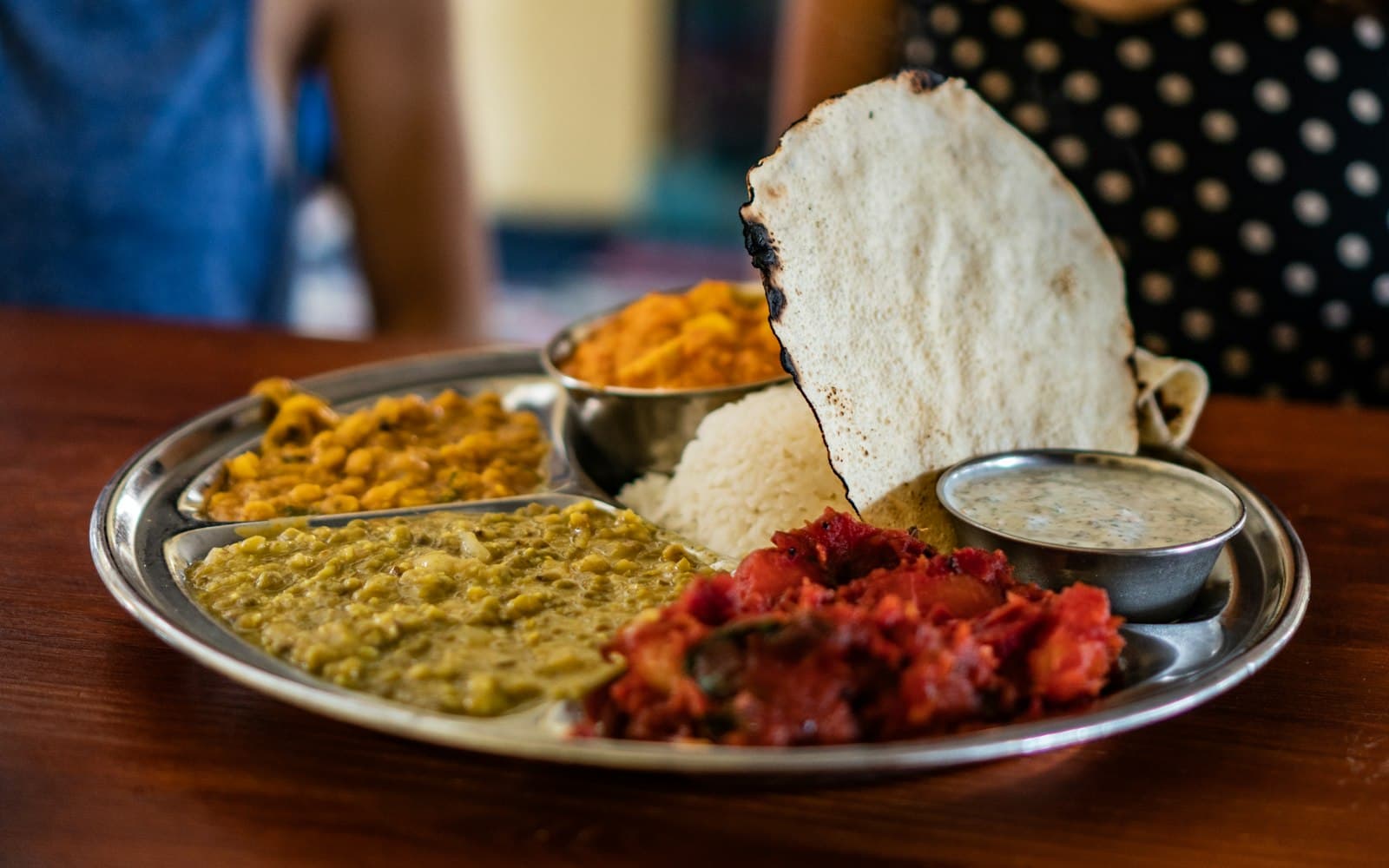
If you eat one thing in the Kullu valley, make it dham. It's the festive vegetarian thali that comes out at weddings and temple fairs, cooked by a hereditary community of cooks called botis, traditionally over slow wood fire in big brass degs. A proper dham is a sequence, not a plate: steamed rice, a rich rajma or chana madra set in a whipped-yoghurt gravy, a tart-sweet meetha (often boondi or a sweet-and-sour dal), khatta made with tamarind or pomegranate seed, and a spoon of something to finish. It is served sitting on the floor, in courses, and you are meant to eat until you slightly regret it.
The catch: real dham is a fair-and-festival food, not an every-day restaurant dish. You won't reliably find it on a menu at 8 pm on a Tuesday. A few Manali kitchens and the Kullu mandi eateries do a fixed dham thali at lunch, usually in the range of ₹150-300 a plate. If a temple fair or a village wedding is on while you're staying with us, ask us. We will happily point you toward the real thing rather than a hotel imitation of it.
“We won't pretend our small family kitchen turns out a full ceremonial dham on demand. What we can do is send you to the botis who've been doing it for three generations, and cook you a home-style madra ourselves the night before you go.”— A note from the hosts
Siddu: the one everyone leaves asking for
Siddu is the dish guests message us about weeks after they've left. It's a soft, fist-sized bread made from wheat dough that's been left to ferment (traditionally with a little yeast), stuffed and then steamed rather than fried, so it comes out pillowy. The classic winter stuffing is a paste of ground walnuts and poppy seeds; savoury versions use spiced urad dal or crushed green peas. It's served hot, drowned in local desi ghee, sometimes with a chutney or a bowl of dal on the side.
Siddu is winter food because steaming a heavy bread makes sense when it's near freezing outside. From roughly November to March you'll find it easily; in peak summer it's rarer. It fills you up fast, so order one to share before you commit to three. Our own kitchen makes siddu on cold mornings when we have the time to let the dough rise, and it's the single most-requested thing on our table.
Trout: the Kullu river fish
Rainbow trout was introduced to these rivers decades ago and it has become the valley's signature fish. It's farmed at government and private trout units along the Beas and its tributaries, and around Kasol and Katrain you'll drive past roadside farms selling it fresh. The honest way to eat it is simple: pan-fried or grilled with salt, a little lemon, sometimes a light rub of local spice, so the fish itself does the talking. A trout meal at a decent riverside dhaba usually runs ₹400-700 depending on the size of the fish, and it's sold by weight.
Two tips from having eaten a lot of it. First, ask that it be cooked fresh, not pre-fried and reheated, which is where roadside trout goes wrong. Second, if you're driving the Kullu-Katrain-Naggar side, that stretch has better and fresher trout than most of what's sold inside Manali town. It's a proper day-trip meal, and we're happy to sketch you a route.
Babru, aktori and the everyday breads
Beyond the headline dishes there's a whole layer of everyday Himachali food that rarely makes it onto tourist menus but is worth hunting for:
- Babru: a Himachali take on kachori, a deep-fried bread stuffed with a spiced black-gram (urad) paste, eaten with tamarind chutney or a potato curry. Morning food.
- Aktori: a pancake made with buckwheat, a Lahaul-Spiti speciality that turns up here too, especially in winter and around festivals.
- Chana madra: chickpeas simmered in a yoghurt-and-ghee gravy, the dish most people fall for at their first dham. Some Manali kitchens serve it a la carte.
- Kullu trout tikka: when a place does it well, marinated and grilled rather than battered, it's the best fish snack in the valley.
- Local rajma: the red kidney beans grown up around Bharmour and the higher villages are smaller and cook softer than the plains kind; a plate of rajma-chawal here genuinely tastes different.
Where to eat near Badgran (our 14-Mile home)
The 14-Mile stretch on the Kullu-Manali highway is dhaba country, and that's a compliment. These are the truck-and-family kitchens that feed people who actually drive this road, which means the food is honest and the rajma-chawal is the real test. Around Patlikuhl and Katrain, a short drive south of us toward Naggar, you'll find some of the better trout and simple Himachali thali stops. For a proper sit-down Himachali meal, the Kullu mandi eateries about 25-30 minutes south do fixed thalis at lunch.
Because we're a minute off the highway and 14 km from Manali town, our guests tend to eat breakfast and dinner with us and use lunches out as an excuse to explore south toward Naggar and Katrain. That's the right rhythm here. We'll tell you which dhaba is doing good siddu that week, because it changes.
Where to eat near Shanag and Old Manali
Our Shanag home is the food-explorer's base. You're 4-5 km from Old Manali, which is a different world of eating: the cafe belt along the Manalsu, running up past Manu Temple, is where you get wood-fired pizza, Israeli platters, big breakfasts, filter coffee and river-view tables. It's not Himachali food, it's traveller food, and some of it is very good. For the local dishes, drop back down toward Manali town and the Vashisht side, where smaller kitchens do siddu, trout and thali without the cafe markup.
A fair warning: Old Manali is seasonal. Many cafes shut or run half-menus from about December through February when the crowd thins and it snows. If you're up in deep winter, the reliable hot food is down in town and, of course, at our own table. In summer the cafe belt is buzzing and worth a slow evening on foot.
How to order like you live here
A few rules we've learned. Eat dham at lunch, not dinner, because that's when it's cooked fresh. Eat siddu in the cold months. Buy trout where the river is, not deep inside town. Treat Old Manali cafes as a mood, not a Himachali meal, and go to the smaller local kitchens when you want the real regional food. And ask locals, including us, what's good that week, because the valley's best eating is seasonal and it moves.
Everything above is food you'll find within an easy drive of either of our homes, and most of it we can either cook a home version of or point you straight to. That was the whole idea in 2021, and it still is: come for the mountains, stay because the food gave you a reason to come back.
Written by the family that runs Persimmon Farmstead — the two boutique hotels near Manali. We write about the valley the way we'd tell a friend at the kitchen table.
Good to know
What is the most famous local food in Manali?
Himachali dham is the valley's signature meal, a festive vegetarian thali of rice, yoghurt-based madra, sweet meetha and tangy khatta, traditionally cooked by hereditary botis over wood fire. Siddu, a steamed stuffed bread served with ghee, is the other dish visitors remember most. Both are Kullu-valley classics rather than pan-Indian restaurant food.
Where can I eat authentic Himachali dham near Manali?
Real dham is a fair-and-festival food, so it isn't on every menu. A few Manali kitchens and the Kullu mandi eateries, about 25-30 minutes south of our Badgran home, serve fixed dham thalis at lunch for roughly ₹150-300. During temple fairs or village weddings you can eat the genuine wood-fire version, and we're glad to point guests toward it.
How much does a trout meal cost near Manali?
Rainbow trout is the valley's signature river fish, farmed along the Beas near Kasol and Katrain. A fresh pan-fried or grilled trout meal at a riverside dhaba usually runs ₹400-700, sold by the weight of the fish. Ask for it cooked fresh rather than pre-fried, and the Kullu-Katrain-Naggar stretch tends to be fresher than town.
Is there good food in Old Manali?
Old Manali's cafe belt along the Manalsu river does wood-fired pizza, Israeli platters, big breakfasts and coffee, which is traveller food rather than Himachali cooking. It's a good evening out and only 4-5 km from our Shanag home. For local dishes like siddu, trout and thali, drop back toward Manali town where smaller kitchens do them without the cafe markup.
When is the best time to eat siddu in Manali?
Siddu is winter food. This soft steamed bread, stuffed with walnut-poppy paste or spiced dal and served drowned in ghee, is easiest to find from about November to March, when a heavy warm bread makes sense in near-freezing weather. It's rarer in peak summer. Our own kitchen makes it on cold mornings, and it's our most-requested dish.
Tell us your dates. We'll confirm, personally.
You send a request, a real host confirms it by WhatsApp — usually within a few hours.